
Docs / Operations
Activity & history
The named trail of every change, org-wide and per record.
OrderDen keeps a complete, named trail of what your team changes — across the whole workspace, per client, and per document.
What gets logged
Every save or change to shared business data, stamped with who did it:
- Clients — created, details updated, contacts / contact methods / addresses added, edited or removed, notes, archived and restored.
- Quotes, orders, invoices — created (one entry for the first save),
status changes, deletions, conversions, shipments, invoicing and payments.
Edits after the first save are itemized: line quantity, price and
discount changes (
"Widget" qty 5 → 8,"Widget" discount none → 10%), added and removed lines, address, terms, discount, tax and shipping edits. - Items and vendors — created, field-level updates, archived, restored, deleted.
- Purchases — created, itemized edits, status, received, payments.
- Attachments and share links — added, removed, created, rotated, revoked.
- Documents leaving the workspace — emailing a quote, order or invoice records every address it went to, the subject, whether a covering note was included and which mail server carried it; creating, rotating or revoking a share link is recorded the same way. So is taking a full data export.
- Manual status overrides — setting a status the app normally maintains itself (a converted quote, an order's shipping state, a paid invoice) is logged as set by hand, so a status that does not match the paperwork is never a mystery.
- Organization settings — templates, email settings, API keys, team changes (invites, roles, removals), renames.
Actions made through the public API are attributed to the API
key by name (API key "Zapier"); a client accepting a quote on their share
link is attributed to the portal. Personal preferences — your dashboard
layout, list columns, theme — are never logged.
Where it shows
- Company Settings → Activity — the whole trail, newest first, and the only place some of it can be read. See below.
- Dashboard → Recent activity — the same feed in short, with links to the record and the client.
- Client pages — the Activity card shows everything about that client and their documents, plus your free-form notes.
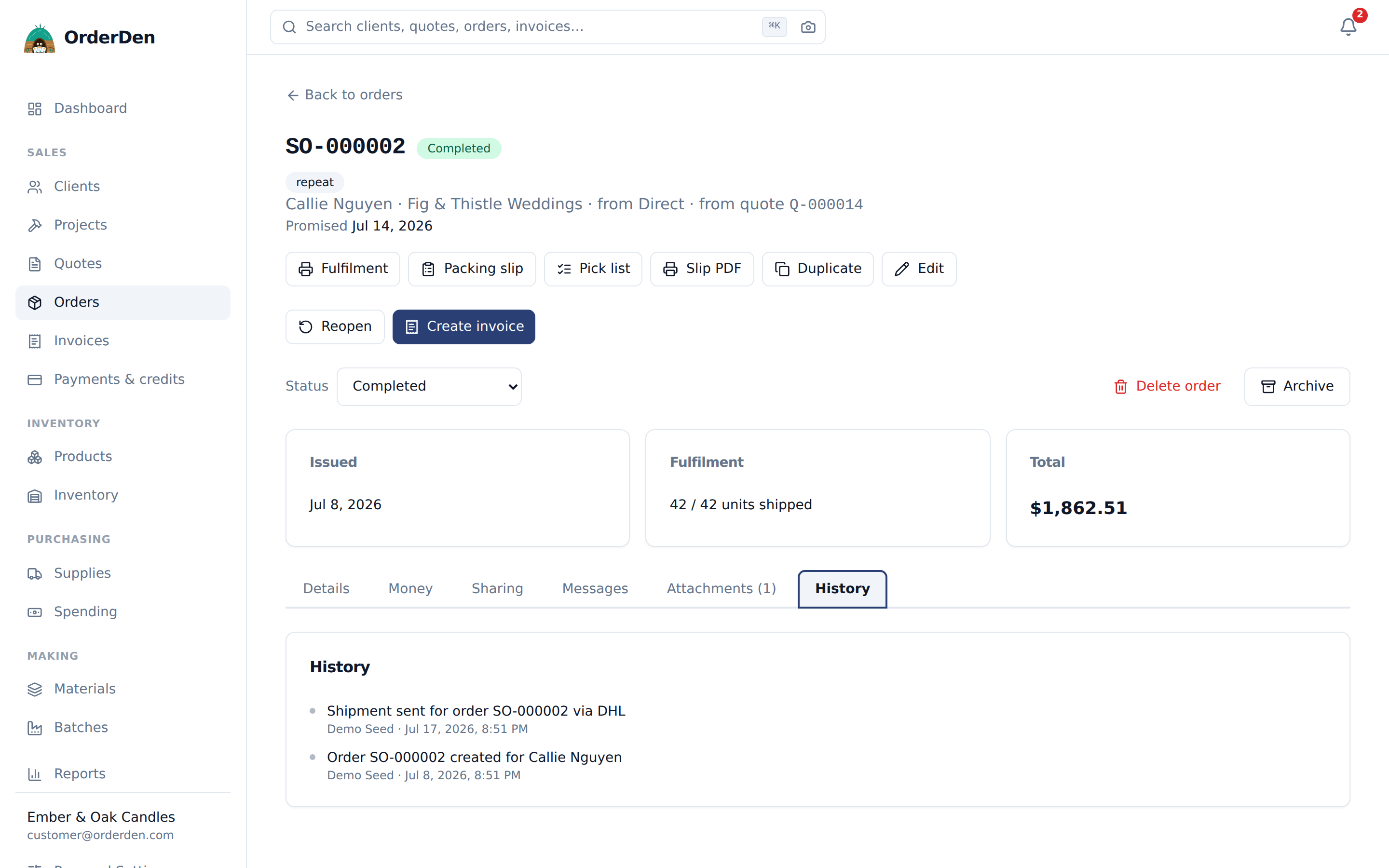
- Every document page — quotes, orders, invoices, purchases, items and vendors each have a History tab or card with their own trail.
Reading the whole workspace's trail
Company Settings → Activity lists every entry in the workspace, newest first, fifty to a page. Owners and admins only — the trail names who did what, which is not everybody's business.
Most entries also appear on the record they are about, so the page earns its keep on the ones that do not: somebody resetting their password, a member invited or removed, a role changed, a setting saved. Those name no client and no document, so there is no other page in the app they could show on.
Five filters narrow it, and they combine:
- Search matches what the entry says, and the record's number or name —
deposit,INV-000041,Halden. - About is the kind of record: an order, an invoice, a stocktake, settings.
- What happened is the kind of entry: created, updated, a status change, a payment, a document sent.
- Who lists everybody who has actually written to the trail, commonest first — including people who have since left, because what they did is still in it. OrderDen itself covers the entries nobody was signed in for: a scheduled charge, a reminder going out, a webhook retried.
- From and To are whole days, inclusive at both ends.
The filters live in the address, so a search you want to come back to is a bookmark, and one you want somebody else to see is a link — they will need to be an owner or admin to open it.
Entries about a record link to it. An entry whose record has since been deleted keeps its number or name on the entry, so the line still reads properly; following the link lands on a not-found page, which is the honest answer.
How far back it goes
History is kept for two years by default, and never less than a year — the window is set by whoever runs your OrderDen (on OrderDen's own hosting, that is us). Entries older than the window are moved out of the app into a compressed archive and stop appearing in the feeds, the Activity card and the History tab. Nothing is thrown away: every archived entry is kept in full, and the operator can retrieve a specific record's history on request.
A trail that has been cut says so. When a client, a document or the workspace-wide trail has entries behind it in the archive, the feed ends with a line naming the date — Entries before 12 September 2024 are archived rather than deleted — so a history that stops is never mistaken for one that was thrown away. You will only see it where something really was archived: a client you added last month, or a workspace younger than the window, shows nothing.
Two years is longer than any of this is normally looked at, so in practice a trail you go looking for is there. If your business needs a longer window for a compliance or audit reason, ask — it is a setting, not a rebuild. And if you want a copy under your own control rather than ours, take a full data export: it includes the history as it stands and is yours to keep for as long as you like.
Notes
Orders and other documents log their first save as a single "created" entry — the itemized history starts with the first edit after that, so drafting stays quiet and changes stay visible. History entries survive deletion of the record they describe (the document number is kept on the entry).
Everything on this page is in the free tier — one person, the whole product, no card.
Start free