
Docs / Selling
Quotes
Priced proposals — send, get accepted, convert to orders.
Quotes are priced proposals you send to a client. An accepted quote converts into an order with one click.
A quote can also start from an enquiry — a request that came in through your public form — with the client matched or created and the request as its first line.
Projects and line kinds
A quote can belong to a project — a whole piece of work, with its own costs and its own margin. Pick one at the top of the form and everything that follows from the quote (the order it converts to, the invoices raised off that order) belongs to the same project without anybody picking it again.
Once a workspace has projects, each line also carries a kind:
- Item — something out of the catalog, or typed in.
- Labour — time, priced at your charge-out rate per hour.
- Material — stuff bought in, priced at cost plus your material markup.
- Note — a heading or a caveat that carries no money at all.
The Labour and Material defaults fill in only when you leave the price at zero; a price you type always wins. Rates live in Company Settings → Rates.
Creating a quote
Pick the client and add line items — from the catalog (with quick-add for new items) or free-form descriptions — each with a quantity, a unit price and an optional line discount. Lines drawn from the catalog show their item number in the first column of the document's line items, with the description beside it. Then:
- Customer PO — optional; the client's own purchase-order reference (up to 100 characters). It shows on the quote page, on the printed, emailed and shared copies, and it's searchable from the quotes list — where you can also turn on a Customer PO column.
- Bill to / Ship to — required on every document. Pick one of the client's saved addresses (or add a new address right from the picker); the text is a snapshot you can edit freely.
- An optional discount on the whole document, taken off the subtotal before tax (see Discounts below).
- Tax on each line — a named rate, or a group that charges several together — filled in from the item and your workspace default, with a Not taxable tick for the odd exception. See Tax.
- An optional flat shipping charge, untaxed unless you pick a Tax on shipping group for it.
- Terms — defaults from the client's payment terms.
- Valid until — quotes past this date show as expiring on the dashboard.
- Public notes (shown to the client on print/email/portal) and internal notes (never shown).
The quote number is assigned automatically from your configured format
(default Q-000001, see Company Settings → Numbering) — or type your own on the
new-quote screen to match an external system. Every document type works this
way: quotes, orders, invoices, purchases and payment receipts all take a number
on the screen that creates them.
A quote may have no line items as long as it still comes to more than zero — freight or tax quoted on its own. Converting a quote with no lines asks you to confirm first, then goes ahead.
Optional lines and options the client picks
Not every quote is one price. Two switches on each line turn a quote into something the client fills in.
Optional makes a line an add-on they can take or leave — the soft-close hinges, the second coat, the extra site visit. An optional line starts unticked: it is priced on the quote but not in the total, so nobody is quoted for something they never asked about.
Option group makes a line one of a set of alternatives. Give two or more
lines the same group name — finish, say — and the client picks exactly one
of them, never both and never neither. The shown as box beside it is what
the choice is called on their copy: Finish. Whichever line names the label
first names it for the whole group, and one of them is quoted as the default —
mark it with the radio button beside the group.
As you type, a What the client chooses panel under the lines reads the groups and add-ons back to you, so a typo in a group name shows up here rather than on the share page. The totals box gains an Options available line: the value of everything on offer and not in the total.
What the client sees
On the share link, the body of the quote is what they are being charged for. Underneath it, Options available lists the add-ons and alternatives with their prices, and a Your options panel gives them checkboxes for the add-ons and a radio group for each choice. The total moves as they tick, and Update my choices sends the answer back: the quote recomputes — total, tax and the deposit it asks for — and the change lands on its History tab, naming what they picked.
When they accept or sign, their choices are frozen. From then on the ticked lines are the agreement, they cannot be changed from the share page, and the variant that converts to an order or an invoice is the one they said yes to. That is also what the signature covers: two quotes identical but for the finish never share a fingerprint.
Templates
The quote you write over and over — the survey-and-fit, the wholesale opening order — lives under Quotes → Templates. A template holds the lines with their options, the terms, the deposit and how long the quote stays open; everything except the client.
- Save as template on any quote makes one from it. An add-on this client took goes back to unticked, so the next one gets to choose; the client, the number and the dates stay behind.
- Use on a template asks for a client (and a project, if you run them) and raises the quote. Prices, costs and tax are worked out as of today, so a template saved in March quotes March's shape at September's prices — never the other way round.
- Edit changes the template without touching the quotes already raised from it. Untick Offer this template to retire one: it leaves the picker and keeps its history.
The list is ordered by how often each has been used, so the one you reach for every week is at the top.
Discounts
A discount is either a percentage (0–100%) or a fixed amount, and you can give one to any line and one to the document as a whole:
- A line discount comes off that line's quantity × unit price; the line's amount shows the discounted figure, with the discount noted under the description on the printed, emailed and shared copies.
- The document discount comes off the subtotal (the sum of the line amounts) before tax, and appears as its own row in the totals.
- The document discount is then shared across the lines in proportion to what each is worth, and each taxable line is taxed on what is left of it — so a discount always reduces the tax charged, and never by more than its share. Shipping is never discounted. A fixed amount never takes a line or a document below zero.
The same discounts work on orders, invoices and purchases, and they follow the document through Convert, Create invoice, Invoice this shipment and Duplicate. Editing a discount is itemized in the History tab like a price change.
The quote page
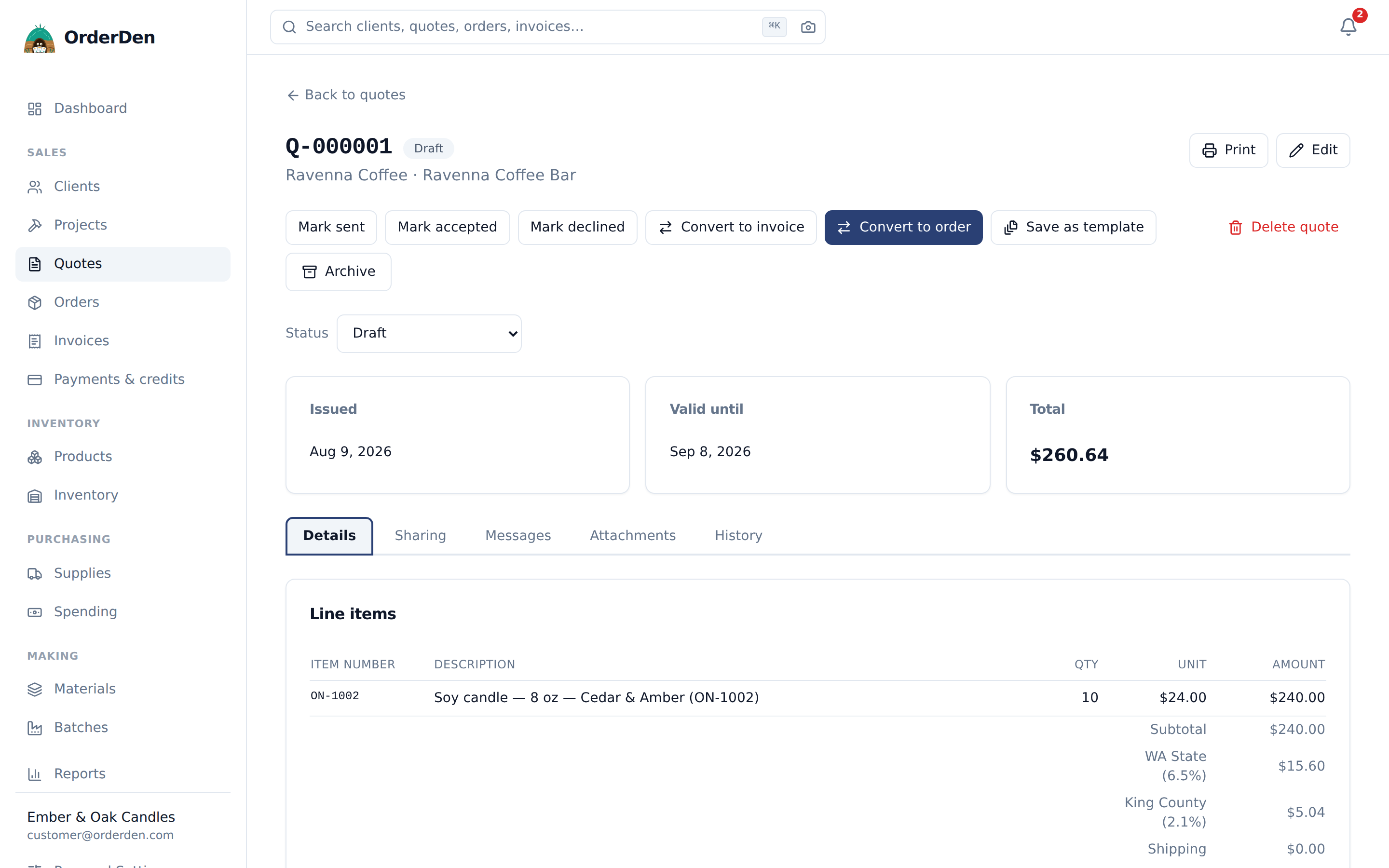
The number, the status, the action buttons and the Issued / Valid until / Total cards sit at the top, whatever you are doing. Everything else is on tabs: Details (the lines, the options, the deposit, the signature and the terms), Sharing (the public link, the follow-ups and the covering email), and Messages, Attachments and History, each with a count where there is something to count.
The tab is part of the address, so a quote open on its history can be bookmarked or sent to somebody as it stands. Only the tab you are looking at is loaded, which is why a long quote opens quickly.
Statuses
Draft → Sent → Accepted / Declined / Expired. Set them from the quote page — or let the client accept or decline directly on their share link. Totals, taxes and shipping are always computed server-side.
Below the action buttons is a Status picker that can set any status by hand, Converted included. Converted is normally reached by converting the quote to an order, so choosing it — or moving off it — asks you to confirm first, and the override is recorded in the quote's history with your name on it.
Delete is always available, even on a converted quote, behind a confirmation that says exactly what will go. Deleting a quote never touches the order it was converted into.
Asking for a deposit
Most workshops do not start a project on a promise. Ask for a deposit on acceptance on the quote form — a percentage or a fixed amount — and the quote shows what is due up front and what is left, on the page, on the PDF and on the client's share link.
Accepting the quote raises the deposit invoice immediately, emails it with your Deposit request wording and (with a payment account connected) lets the client pay it there and then. The balance is invoiced later with the deposit deducted as its own line. Picking a payment term that already asks for a deposit — "50% deposit, balance on delivery" — fills the numbers in for you.
Full detail in Deposits, instalments and final invoices.
Getting it signed
New quotes ask the client to sign before they can accept. On their share link, Accept becomes a signature box — their name typed in a script face, or drawn with a finger — and the record kept is the date, the address it came from, the browser, the exact wording they agreed to, and a fingerprint of the quote as it stood. Signing is accepting, so a signed quote is never left sitting as open.
Each quote carries its own terms and conditions, written under Signature and terms on the quote form and printed after the lines. They are copied onto the quote as it is written, so changing your default terms never rewrites what somebody already signed.
The quote page then says, in as many words, whether the quote still matches what was signed. Turn signing off per quote, or for new quotes in Company Settings → Documents.
Full detail in Signatures on quotes.
Following it up
A quote sitting unanswered is the cheapest work in the business to recover, so OrderDen asks again for you: by default three days after the quote was raised and once more at seven, on the schedule in Company Settings → Reminders.
Following up stops the moment the client accepts or declines, and when the quote passes its valid until date — an expired quote has been answered by the calendar.
The Follow-ups card under Sharing shows when the next one goes and everything already sent, with a Pause switch for this one quote and a Send now button. See Reminders, follow-ups and status emails.
Converting to an order
Convert to order turns an accepted quote into a new order, copying its lines, discounts, per-line tax, addresses and customer PO. The quote becomes Converted (locked) and the two documents stay linked both ways — including shared attachment visibility.
Only the lines the client actually chose come across: an add-on they passed on is not work to be scheduled, and the alternative they did not pick never was. The choice travels in the description — Worktop (Finish) — because on the order the group is gone and only the winner is left.
Invoicing a quote directly
Plenty of businesses have nothing to ship. A designer, a consultant, a bookkeeper: for them the order stage is a page nobody opens. Convert to invoice raises the invoice straight off the quote, with no order in between — same lines, same tax, same discounts, and a deposit already paid on the quote deducted from it.
Which buttons the quote page offers is set in Company Settings → Sales defaults:
- Ask me each time (the default) — both buttons, decide per quote.
- An order, then an invoice — for a workspace that builds and ships things.
- An invoice, with no order in between — for one that sells time.
Both doors stay open through the API whichever you pick.
Starting a project from a quote
Some jobs are not one document. A commission has hours on it, materials off the shelf, a courier, and maybe three invoices over two months. Convert to project on the quote page opens a project for that work, with the quote's client and its value as the contract figure.
It is the one conversion that does not consume the quote. The quote keeps its status and its lines and simply points at the project — so you can still convert it to an order or an invoice afterwards, and the project reads the quote's lines for what was agreed and what it was costed at. The first line names the project; rename it on the project's Details tab.
Nothing happens automatically on acceptance. A stockist accepting a reorder for 200 candles should not sprout a project, so the button is always yours to press.
Sending it out
From the quote page's Sharing tab: Print a themed PDF-style document, Email it (with PDF attached) using your configured mail server, or create a share link your client can open without an account.
The email form starts with no recipient filled in — sending to the wrong person is worse than typing an address. Underneath it, everyone on the account is one click: the client's own contacts (with their titles) and your workspace's members, so copying a colleague is as easy as addressing the client. Add as many as you need, or type an address by hand.
Every send is recorded on the History tab: who it went to, the subject, whether you included a note, which mail server carried it and who sent it. Creating, rotating or revoking a share link is recorded the same way. Every edit after the first save — line quantities, prices, discounts, added or removed lines, field changes — is recorded on the quote's History tab with who made it.
Everything on this page is in the free tier — one person, the whole product, no card.
Start free