
Docs / Basics
Clients
Company profiles, contacts, addresses, terms and notes.
Clients are the companies (or people) you sell to. Every quote, order and invoice belongs to a client.
The client page
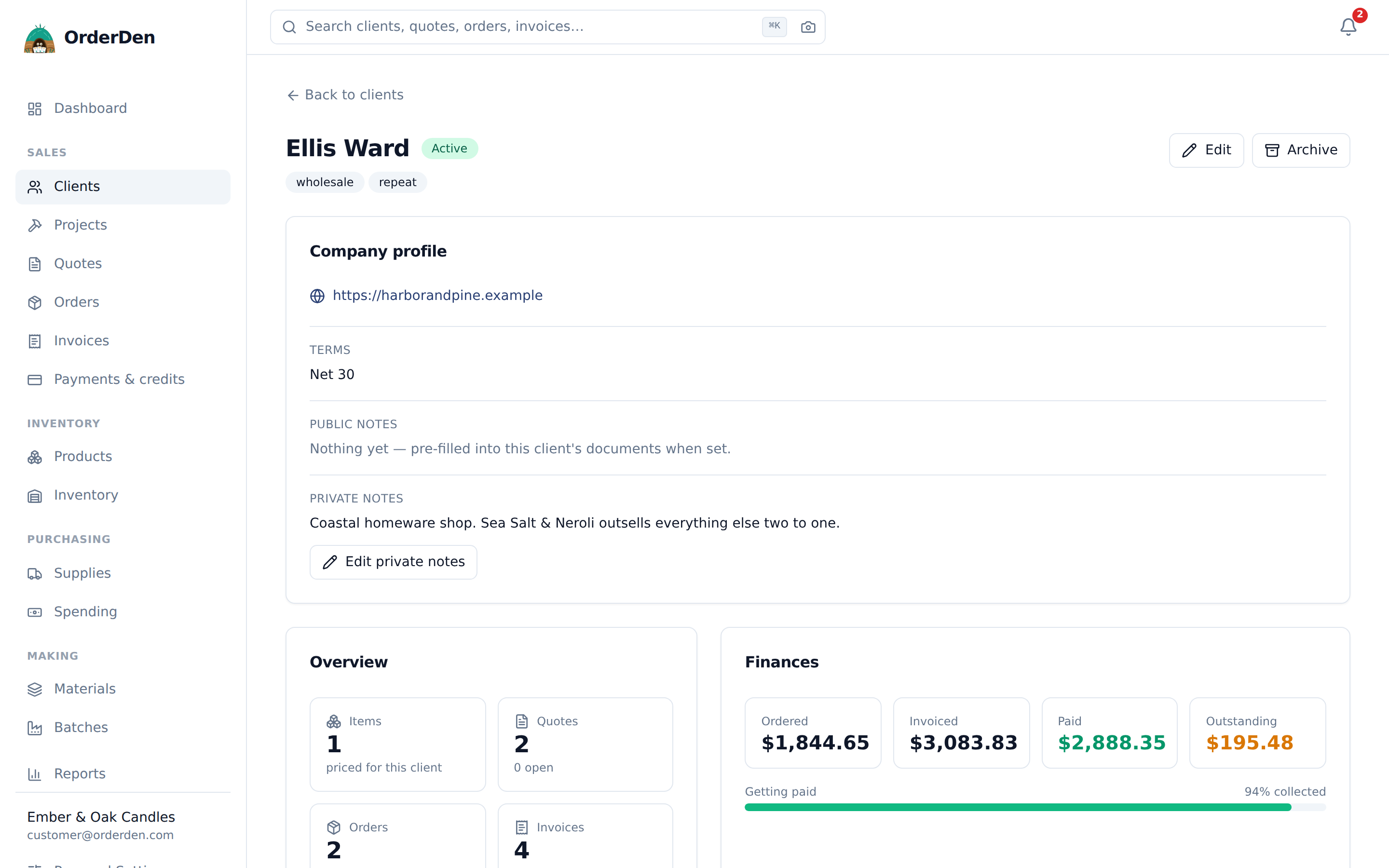
A client's page opens on Overview and splits the rest across tabs, so the thing you are looking for is one click away rather than several screens down. A tab that has something in it says how many — Contacts (3), Files (2) — so you can see the reason to open it without opening it, and nothing behind a tab is loaded until you do.
- Overview — the company profile and the notes, both editable in place, the rollup below, and the money card: credit on account, what they owe, and Record payment.
- Contacts — the people, the addresses, and Portal access: who at this client can sign in. The count is the number of contacts.
- Sales — what their new documents start from (terms, price list, quote follow-ups), their projects, their latest orders with one-click Reorder, and the recurring invoices running for them. The count is their orders.
- Money — how they are billed and taxed, the statement of account, and the cards they have on file.
- Files — everything uploaded to the client record.
- Activity — the trail, and Add note.
The tab is in the address (?tab=contacts), so a link to a client's
contacts opens on their contacts. Archive and Restore sit above the
tabs, on every one of them.
Everything edits where you read it
There is no Edit screen. Each card on a client's page is the fields it holds plus its own Save, so you change the thing you are looking at and stay where you are — Company profile and Notes on Overview, Sales defaults (terms, price list, quote follow-ups) on Sales, Billing & tax (tax exemption, tax ID, late fees, payment reminders) on Money. Contacts, addresses and portal access have always worked this way.
Each card saves only its own fields and says Saved. beside its own button, so two people editing different cards cannot overwrite each other. Emptying a box clears the stored value. If you start typing in a card and then click away to another tab, the browser asks before leaving.
The client record
A client carries:
- Name & company — plus an optional website and free-form tags for segmenting (wholesale, priority, …).
- Contacts — the people you deal with, each with a name, optional project title, roles and a primary flag, editable inline. Every optional field can be cleared as well as changed: empty the title box and save, and the title is gone.
- Contact methods — emails, phones and other ways to reach the company. Contacts and contact methods are what the send-email form offers as one-click recipients on quotes, orders and invoices.
- Addresses — any number, each labelled and flagged for billing, shipping, both or neither. One address can be the default billing and one the default shipping — those pre-fill the Bill to / Ship to pickers on new documents.
- Payment terms — one of your own named terms (Company Settings → Payment terms), pre-selected on this client's quotes and invoices. An invoice's due date follows from it, and a term that asks for a deposit makes their quotes ask for one too.
- Tax — mark a client tax exempt and nothing they are sold is ever taxed: their document lines come in untaxed and locked, and the document carries a "Tax exempt" badge with the exemption reason you recorded (a resale certificate number, say). Their own Tax ID prints alongside it. See Tax.
- Price list — which of your price lists this client is charged off. A shop on the wholesale sheet gets trade prices on every quote, order and receipt — with that sheet's minimums and case packs enforced — and their card says so. Leave it empty and they pay your default list.
- Public notes — pre-filled into the public notes of this client's documents (visible to the client).
- Private notes — internal notes about the relationship, never shown to the client.
Overview rollup
The Overview tab's rollup card totals the relationship: quotes (open vs all), orders and their value, invoices, items priced for this client, and the money picture — ordered, invoiced, paid and outstanding.
Activity & notes
The Activity tab is the client's timeline: every change to the client itself and to their quotes, orders and invoices, with the team member's name on each entry, plus free-form notes you add with Add note. See Activity & history.
Attachments
The Files tab holds contracts, tax certificates, artwork or any other file uploaded to the client record (10 MB per file). Choosing a file starts the upload — there is no separate Upload button — and each file shows its own progress bar as it goes; pick several at once and they upload in turn. Deleting a file asks you to confirm, because it cannot be undone. Documents have their own attachments too, and they work exactly the same way.
Importing and exporting
Already have your client list in a spreadsheet? Import on the Clients list loads a CSV — names, emails, phones, tags, terms, a billing address and a shipping address — with a column-mapping step, a preview and a one-click undo. A Payment terms column is matched by name against your own list, ignoring case and spacing; a name nothing matches is ignored rather than failing the row. See Importing your spreadsheet.
Export CSV takes the list back out again
(Search & lists) — and it carries the whole address
book, not just what is on screen. Whichever columns you have showing, the file
also has Email, Phone, Website, Payment terms, Notes, the
six Billing address columns, the six Shipping address columns and
Other contacts (every further way of reaching them, written
EMAIL: accounts@harbour.test (Accounts)). That is what makes the file worth
having: load it straight back into OrderDen and the address book comes back
with it, no column mapping to do.
One address in the file is the client's default for billing and shipping, which is what a one-address sheet means; a different shipping address is saved as a second address. Re-importing with Update them matches an address on its street and rewrites it in place, and never deletes one you added in the app.
Your data takes everything out at once — clients, contacts, documents and files — in a single zip.
Archiving
Clients are never deleted — Archive hides a client from day-to-day lists (and keeps every document intact); Restore brings them back.
Money: credit and payments
The money card on the client's Overview shows what they hold in credit on account and what they owe across their open invoices.
Credit builds up when a credit note is issued and not immediately applied or refunded, and when somebody pays more than they owed. Credit history opens the ledger behind the balance — every movement in order, each showing the balance it produced — so the number is always explainable.
Record payment takes the amount that arrived and lets you put it against however many of their open invoices it settles: one transfer clearing three months is one payment here, not three fictions. Leave the boxes empty and it goes against what they owe, oldest first; anything left over becomes credit.
Cards on file, and plans that bill them
Two more cards fill in once you have connected a payment account (Settings → Payments):
- Payment methods, on the Money tab — what they have left on file, which one is the default, and how each came to be there: saved by the client in their portal, or added by you holding their written authorisation. Removing one detaches it at the processor too.
- Recurring invoices, on the Sales tab — the retainers, maintenance plans and subscriptions running for them, and what those come to a month.
The client form also carries never charge a late fee, which takes this one client out of the workspace's late-fee rules entirely. See Recurring invoices, cards on file and late fees.
The client who asked not to be chased
Under Automatic messages on the client form are two switches: no automatic payment reminders and no automatic quote follow-ups. Either one covers every document that client has and every one they ever will, so the client who told you they settle everything on the 30th and would rather not get emails about it is recorded once rather than remembered every time you raise an invoice.
Neither stops you sending anything by hand. Send now on a document still works, and so does emailing the document itself — these switch off the schedule, not the person. See Reminders and follow-ups.
Merging duplicate clients
Every workspace that has ever imported a spreadsheet ends up with "Harbour Coffee", "Harbour Coffee Roasters" and "harbour coffee roasters ltd" — three records, one customer, and three sets of invoices that no statement, credit balance or ageing report adds up correctly.
The Clients list carries a Find duplicates panel that groups the likely pairs two ways:
- Same email address. As close to proof as this gets — nobody sets up two accounts for one inbox on purpose.
- Same name at the same postcode. The same company typed twice, at the same door. Name alone is deliberately not enough: two "Bloom & Co" in different towns are two businesses.
The panel is not there at all when you have no duplicates.
Merge these opens a dialog that asks two questions. First, which record survives — the one with the most documents is proposed, because that is the one on the most paperwork. Second, which values to keep, field by field, for anything the records disagree about; everything else keeps the survivor's own value. Tags are the exception: a label somebody put on either record still describes the customer afterwards, so they are combined.
What a merge does:
- Moves everything onto the survivor — every quote, order, invoice, sales receipt, credit note and payment, plus addresses, contacts, portal accounts, cards on file, credit history, projects, shared links, files, statements and the activity trail. It is one transaction: a merge never half-happens.
- Adds up credit on account, because that is money rather than a preference.
- Archives the emptied records rather than deleting them, so an old link, an export or a webhook payload still finds something at their address.
- Leaves a note on both sides — the survivor says what it absorbed, and each merged record says where its history went.
A merge is refused, with nothing changed, when two of the records have a portal sign-in for the same email address: that would leave one client with two accounts for one person and no way to tell which is live. Revoke the duplicate account first, then merge. Ten clients at a time is the most it will take.
Merging is on the API too: GET /clients/duplicates for the groups and
POST /clients/merge to do it — see the API reference.
Portal access
Portal access, on the client's Contacts tab, is where you give somebody at this client an account: their email address, and they can sign in to see every quote, order and invoice of theirs, message you on the document it concerns, and send you files. No password is ever set — they ask for a sign-in link when they want one. Remove ends it immediately. See Client portal.
Everything on this page is in the free tier — one person, the whole product, no card.
Start free